


Models of Understanding Depressive and Bipolar Disorders
- hina khan
- Apr 23, 2023
- 4 min read

Welcome back to module 2 mood disorders. This is Lecture 3. In this lecture, we're going to talk about the prevailing models used to understand
depressive and bipolar disorders. Think back to module 1, when we spent a
great deal of time talking about the major models of psychological abnormality. The dominant model for
understanding both depressive and bipolar disorders is the biological model. Let's begin by considering
depressive disorders. There is a large research base suggesting
that depression is caused by low levels of two specific neurotransmitters,
serotonin and norepinephrine. This connection was discovered by accident
in the 1950s when scientists observed that certain medications used to
treat high blood pressure caused depressive symptoms in
the people who took them. These medications,
in addition to lowering blood pressure, suppressed serotonin and
norepinephrine activity in the brain. This finding led to the theory that
depressive disorders are associated with low serotonin and
low epinephrine activity in the brain. And it launched research into the
development of medications that increase serotonin and norepinephrine activity
in the brains of depressed people. Not all research into the biological
basis of depression has investigated neurotransmitter activity. There's been a great deal of research
into the genetic basis of depression. This research has investigated the extent
to which depression can be passed from parent to child. Studies have shown that depression
does in fact run in families. Studies of identical and fraternal twins have also demonstrated
a strong genetic component. If one identical twin has
a depressive disorder, there's a 38% chance the other
twin will develop it too. Among fraternal twins if
one twin has the disorder, the other twin has a 20%
chance of developing it. Let's turn now to the biological
model of bipolar disorders. Scientific research into the biological
basis of bipolar disorders has also investigated the roles played by
neurotransmitters and genetic factors. The findings are very interesting,
like people with depression, people with bipolar disorder have
also been found to have low serotonin activity in their brains. However, unlike depression,
bipolar disorder has been found to be associated with high levels
of norepinephrine activity. These findings have led researchers to
believe that the interactions between these two neurotransmitters influence
whether a person will experience uni polar depressive disorder or
bipolar disorder. And what of the research into
the genetic basis of bipolar disorder? As you may recall from the last lecture, bipolar disorder effects between 1% and
2.6% of the world's population. In families however,
the prevalence is very different. If an identical twin has bipolar disorder, there is a 40% to a 70% chance
the other twin will develop it too. Among fraternal twins and non twin
siblings, if one sibling has the illness, the other siblings each have a 5%
to 10% chance of developing it. Clearly, there is strong evidence for
the heritability of bipolar disorder. Are there any other models that are in
wide use to understand these disorders? For bipolar illness, the answer's no. A biological model is the only
accepted framework for understanding the origins
of this disorder. The same cannot be said for
depression however. Several other models are used to
understand depressive disorders, the most prevalent of which is
the cognitive behavioral model. Let's consider it briefly. As you may recall from the first module,
the cognitive behavioral model asserts that psychological abnormality occurs
when a person's thought patterns become significantly distorted and
impact both emotions and behavior. Aaron Beck is widely known for his
cognitive behavioral theory of depression. According to this theory, depressed people have identifiable
patterns of negative thinking. Beck developed the concept
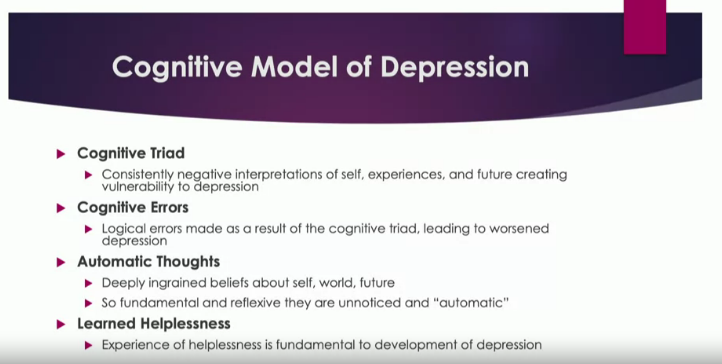
of the cognitive triad, which is the notion that depressed
people interpret their life experiences, themselves and their futures and
consistently negative ways. And this is what causes the depression. Beck asserted, the cognitive triad leads
depressed people to make errors and thinking which are logical errors
that worsen their depression. For example, a depressed person with a
negative view of their future may receive a poor grade on an exam and think I'm
not smart enough to pass this class, I'm going to be a failure forever. I may as well give up. In fact, it is not logical to assume
future failure based upon one poor grade. Beck's theory also emphasizes
automatic thoughts, which our beliefs about the self world and
future that are so fundamental and so deeply ingrained that we do not
notice them, they're automatic. Beck theorized that depressed people
demonstrate a pattern of deeply negative automatic thoughts. For example, I will never succeed
no matter how hard I try or no one would ever want to be with me or
I'm not as smart as other people. Another well known cognitive behavioral
theory of depression was developed by martin Seligman and
based in early animal learning studies. This is called the learned
helplessness model. The learned helplessness model asserts
that a feeling of helplessness is fundamental to the development and
experience of depression. If a person has repeated
experiences in which they try and fail to effect change in themselves,
their external world or their personal future,
they become depressed. There's been a great deal of research
conducted into the validity of a CBT model of depression and there's an impressive
body of data supporting it. The question of cause and effect remains. However, does a pattern of negative
thinking cause depression or does depression lead to
a pattern of negative thinking? In our next lecture, will take a look
at treatment interventions for mood disorders.



Comments